As we step into 2026, the global construction industry is undergoing a profound transformation in efficiency and safety. With the increasing number of large-scale projects such as bridge engineering, tunnel construction, power plants, and oil refineries, traditional scaffolding systems can no longer meet the demanding schedule and safety requirements. Against this backdrop, the selection of ringlock scaffolding systems has become a core strategic decision that determines a project's profitability and construction safety.
Faced with numerous suppliers in the market, how can contractors accurately identify partners with both a global perspective and deep technical expertise? Drawing on GETO's industry-leading experience, this article provides an in-depth analysis of how to select a ringlock scaffolding supplier in 2026, and explains why GETO ringlock scaffolding systems are becoming the preferred choice for large-scale engineering projects worldwide.
Why Is Choosing the Right Supplier Even More Critical in 2026?
The construction market in 2026 exhibits three distinct characteristics that directly impact scaffolding selection:
1. Increase in Large-Scale Infrastructure Projects
Projects such as bridges, tunnels, power plants, and oil refineries place extremely high demands on scaffolding load capacity and structural strength. With a maximum single-leg load capacity of up to 19 tons (60 series), ringlock scaffolding has become the ideal choice for these heavy-duty applications.
2. Compressed Project Timelines
Every day of delay translates into massive financial costs. Ringlock scaffolding features a unique rosette self-locking pin design that enables quick assembly and significantly improves construction efficiency.
3. Elevated Safety Standards
A global "zero-tolerance" policy regarding construction safety has made compliance with international safety standards a mandatory market entry requirement. The hot-dip galvanizing anti-corrosion process and reliable structural design of ringlock scaffolding provide safety assurance on construction sites.
What Is a Ringlock Scaffolding System?
Core Definition
A ringlock scaffolding system (also known as rosette scaffolding) is a modular scaffolding system primarily manufactured using steel materials (Q355 and Q235). It includes M48 and M60 standard series, with standard lengths ranging from 500mm to 3000mm. It is widely used in large-scale engineering projects such as bridges, tunnels, factories, power plants, and oil refineries.
Main Components
A complete ringlock scaffolding system typically includes:
- Standard: The primary vertical load-bearing member
- Ledger: Horizontally connects standards to form a stable frame structure
- Diagonal Brace: Provides shear resistance and prevents structural deformation
- Jack Base: Transfers loads to the ground with height adjustability
- Rosette: The eight-hole connecting disc welded onto the standard – the core connecting component
- Wedge Pin: Used to secure ledgers and diagonal braces to the rosette
Two System Series
- 48mm System: Mainly applied to civil construction projects, operating platforms, and other projects with relatively small loads
- 60mm System: Mainly applied to municipal engineering, cast-in-place beams for rail transit, swivel bridges, freight viaducts, and other projects with relatively large loads
Ringlock Scaffolding vs. Traditional Scaffolding: A Comprehensive Comparison
In 2026, ringlock scaffolding is rapidly replacing traditional coupler scaffolding due to its superior load capacity and construction efficiency.
|
Feature |
Traditional Coupler Scaffolding |
Ringlock Scaffolding |
|
Single-Leg Load Capacity |
Lower |
Up to 19 tons (60 series) |
|
Anti-Corrosion Treatment |
Paint or galvanized |
Hot-dip galvanized, long service life |
|
Installation Speed |
Slow (many couplers, easy to lose) |
Fast (rosette self-locking pin design) |
|
Labor Requirements |
High |
Low |
|
Steel Consumption |
High |
Low, lighter weight |
|
Transportation Cost |
High |
Low |
|
Safety |
Moderate |
High |
|
Applicable Scenarios |
General construction |
Bridges, tunnels, heavy-load projects |
As shown in the table above, ringlock scaffolding offers significant advantages in load capacity, safety, construction efficiency, and cost control.
Core Criteria for Selecting a High-Quality Ringlock Scaffolding Supplier
When selecting a ringlock scaffolding supplier, we recommend evaluating the following four dimensions:
1. Material Quality and Standards
High-quality ringlock scaffolding is manufactured from Q355 and Q235 steel. When evaluating suppliers, request material certification documents, yield strength data, and quality control procedure documentation. GETO's ringlock scaffolding is strictly manufactured to international standards, ensuring quality of every component.
2. Depth of Product Portfolio
A top-tier supplier should provide a complete ringlock scaffolding ecosystem, including standards, ledgers, diagonal braces, jack bases, and all accessories. Suppliers with limited product ranges force contractors to source missing components from other vendors, leading to compatibility issues. GETO offers a full range of products from 48 series to 60 series, with lengths from 300mm to 3000mm.
3. Anti-Corrosion Process and Service Life
Hot-dip galvanizing is a key feature of high-quality ringlock scaffolding. This process forms a uniform zinc layer on the product surface, effectively preventing rust and extending service life. Compared to traditional paint treatment, hot-dip galvanized scaffolding is more suitable for long-term outdoor use and harsh environments.
4. Technical Support and Project Experience
Does the supplier have experience with large-scale engineering projects? GETO's ringlock scaffolding has been successfully applied to numerous bridge projects, tunnel projects, power plants, oil refineries, and other special factory projects, accumulating rich engineering practice experience.
GETO Ringlock Scaffolding System Overview
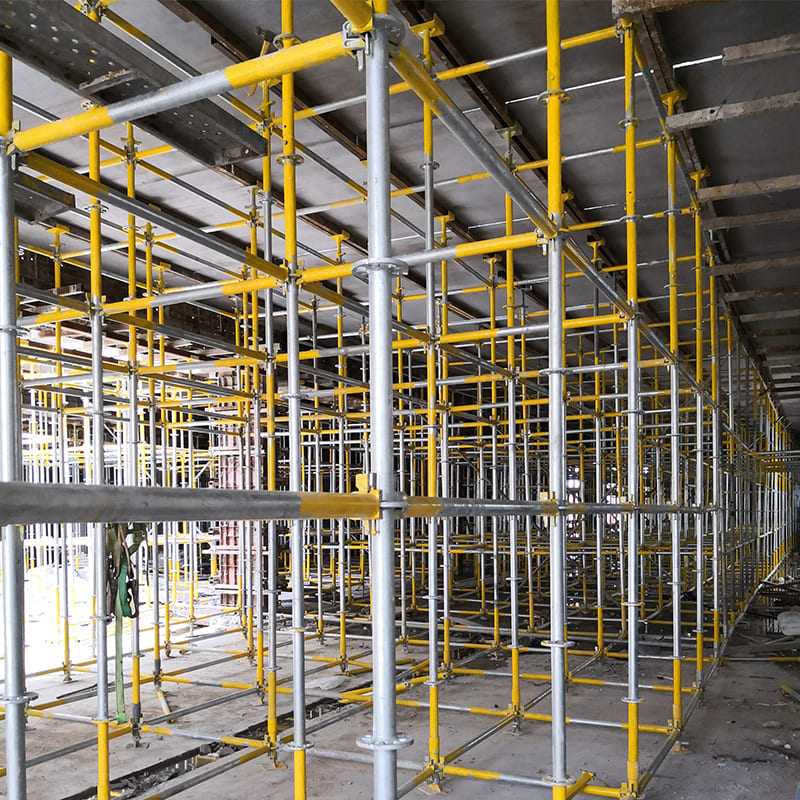
Product Description
GETO ringlock scaffolding is a steel modular shoring system manufactured using Q355 and Q235 steel, including M48 and M60 standard series. Standard lengths range from 500mm to 3000mm, allowing flexible configuration based on project requirements. The system is widely used in bridge engineering, tunnel engineering, factory buildings, elevated water towers, power plants, oil refineries, and other special factories. It can also be used in projects such as crossing bridges, cross beams, storage shelves, large stage and background frames.
Main Components
- Standard: Vertical load-bearing member with welded eight-hole rosette
- Ledger: Horizontal member with wedge-shaped heads at both ends for connecting to rosettes
- Diagonal Brace: Diagonal support providing lateral stability
- Jack Base: Height-adjustable bottom support
Main Accessories
- Rosette: Eight-hole connecting disc welded onto the standard
- Wedge Pin: Wedge-shaped pin used to lock ledger and diagonal brace heads
- Ledger Head: Connecting head at the end of the ledger
- Diagonal Head: Connecting head at the end of the diagonal brace
Product Advantages
1. Strong Load-Bearing Capacity
The load capacity of a single 60 series standard reaches up to 19 tons, meeting the heavy-load requirements of large-scale projects such as bridges and cast-in-place beams for rail transit.
2. Safe and Reliable
The hot-dip galvanizing anti-corrosion process forms a uniform zinc layer protection, effectively preventing rust and ensuring a long service life. The unique rosette self-locking pin design ensures firm connections and structural stability.
3. Quick Assembly
The unique rosette self-locking pin design makes assembly and disassembly simple and fast. Compared to traditional coupler scaffolding, ringlock scaffolding eliminates many loose couplers, avoiding coupler loss and damage, significantly improving construction efficiency.
4. Economical and Practical
Less steel consumption and lighter weight reduce transportation and labor costs. At the same time, hot-dip galvanizing extends product service life and increases reuse rates, making it more economical over the long term.
Application Scenarios

48mm System Main Applications
- Civil construction projects
- Operating platforms
- Work platform projects
- Projects with relatively small loads
60mm System Main Applications
- Municipal engineering
- Cast-in-place beams for rail transit
- Swivel bridges
- Freight viaducts
- Projects with relatively large loads
Other Application Scenarios
- Tunnel engineering support
- Power plant and oil refinery maintenance platforms
- Factory building construction
- Crossing bridges and cross beams
- Large stage and background frames
2026 Construction Trends: Intelligence and Green Construction
In the future, scaffolding will no longer be merely passive structures. Emerging industry trends include:
- BIM Integration: 3D dynamic simulation before construction to identify potential clashes in advance and optimize scaffolding layout
- Safety Monitoring: Sensor technology for real-time load status monitoring on large-scale projects
- Green Construction: High-quality hot-dip galvanizing extends product life, reduces replacement frequency, and minimizes environmental impact over the lifecycle
Frequently Asked Questions
Q1: What is the main material of ringlock scaffolding?
A: GETO ringlock scaffolding is primarily manufactured using Q355 and Q235 steel, offering excellent strength and toughness for various large-scale engineering projects.
Q2: What is the difference between 48 series and 60 series?
A: The 48mm system has a standard outer diameter of 48.3mm and is mainly used for civil construction projects, operating platforms, and projects with relatively small loads. The 60mm system has a standard outer diameter of 60mm with a single-leg load capacity of up to 19 tons, mainly used for municipal engineering, cast-in-place beams for rail transit, and other projects with relatively large loads.
Q3: What advantages does ringlock scaffolding have over traditional coupler scaffolding?
A: Ringlock scaffolding offers stronger load capacity, faster installation speed, less steel consumption, and higher safety. The unique rosette self-locking pin design improves assembly efficiency by over 50%.
Q4: What projects is ringlock scaffolding suitable for?
A: It is suitable for bridge engineering, tunnel engineering, factory buildings, power plants, oil refineries, and other special factories. It can also be used for crossing bridges, cross beams, storage shelves, large stage and background frames.
Q5: How do I choose a ringlock scaffolding supplier?
A: Focus on material quality (Q355/Q235), product portfolio completeness, hot-dip galvanizing process, large-scale project experience, and technical support capabilities.
Conclusion
In the competitive construction industry of 2026, choosing the right ringlock scaffolding supplier is critical to project success. A high-quality ringlock scaffolding system not only provides safety protection on the construction site but also serves as an important tool for improving profitability and construction efficiency.
GETO ringlock scaffolding system is manufactured from high-quality Q355 and Q235 steel with hot-dip galvanizing anti-corrosion treatment, offering strong load capacity, safety and reliability, quick assembly, and excellent cost-effectiveness. Whether your project involves bridge engineering, tunnel construction, power plant construction, or large stage setup, GETO provides the right 48 series or 60 series solution.
If you are seeking a partner with a global perspective, uncompromising quality, and comprehensive one-stop solutions, GETO is your ideal choice.
Contact GETO today to discuss your ringlock scaffolding requirements and request a project-specific quotation.